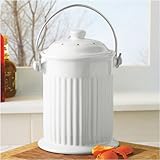

When creating garden compost it is important to mix your ingredients well. The best way to incorporate plenty of green varied matter is to add lots of kitchen scraps into the mix. The best way to do this is to buy a Kitchen Compost Pail.
Best Priced Kitchen Compost Pails
Here at the Kitchen Composter we are always looking for good deals. We found that there is a huge range of Kitchen Compost Pails at amazon . Prices are low, and the replacement filters, which should last around six months, are also available at only around $6 too.
. Prices are low, and the replacement filters, which should last around six months, are also available at only around $6 too.Kitchen Compost Pails come in a variety of shapes and sizes. The only ones worth buying really are those that incorporate a carbon filter system to ensure all odors are kept to an absolute minimum even if you do not have time to empty the crock every day. These Compost Pails for Kitchens are not expensive and can really brighten up any kitchen counter top.
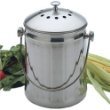

A range of designs are available from traditional ceramics and stoneware, to bright colors and chrome or stainless steel finishes. Whatever the current theme of your kitchen design there should be a compost crock to suit.
Compost Pails are best with one sturdy carry handle. This makes it simple to carry even a full crock of kitchen scraps out to the backyard compost bin. Most are dishwasher safe too, making cleaning simple.
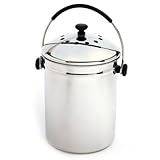

Under counter kitchen compost buckets can be less attractive, and much larger as they are kept out of site, but for anything on the countertop, a one gallon size is most suitable and most attractive. Having a container on the counter for collecting vegetable peelings, coffee grounds and so on, makes life simple. No-one should forget to save their scraps for adding to the compost bin if there is something close to hand on the counter.
Since many gardeners make do with just a bowl of even sandwich box to collect the kitchen bits and bobs, buying a Compost Pail of the kitchen as a gift is a great idea. You can buy something to brighten up a friends kitchen for around $25 and you will certainly be making life more convenient for the gardener in question.
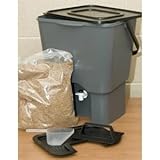

 . This is the only method of Kitchen Composting to deal with all types fo food scraps in a completely natural way. Most gardeners agree adding certain food waste to the garden composter is a bad idea, as it may be slow to break down, attractive to vermin and potentially hazardous to handle.